Value is one of the most fundamental concepts in drawing and painting, and one of the least understood by beginners. Most people starting out focus on colour — choosing the right hue, mixing accurately, getting the colour temperature right. But experienced artists know that colour is secondary. Value is what makes a drawing read as solid, three-dimensional, and convincing. Get it wrong and no amount of colour work will save the piece.
This guide explains what value is, why it matters more than colour, and how to start training your eye to see it.
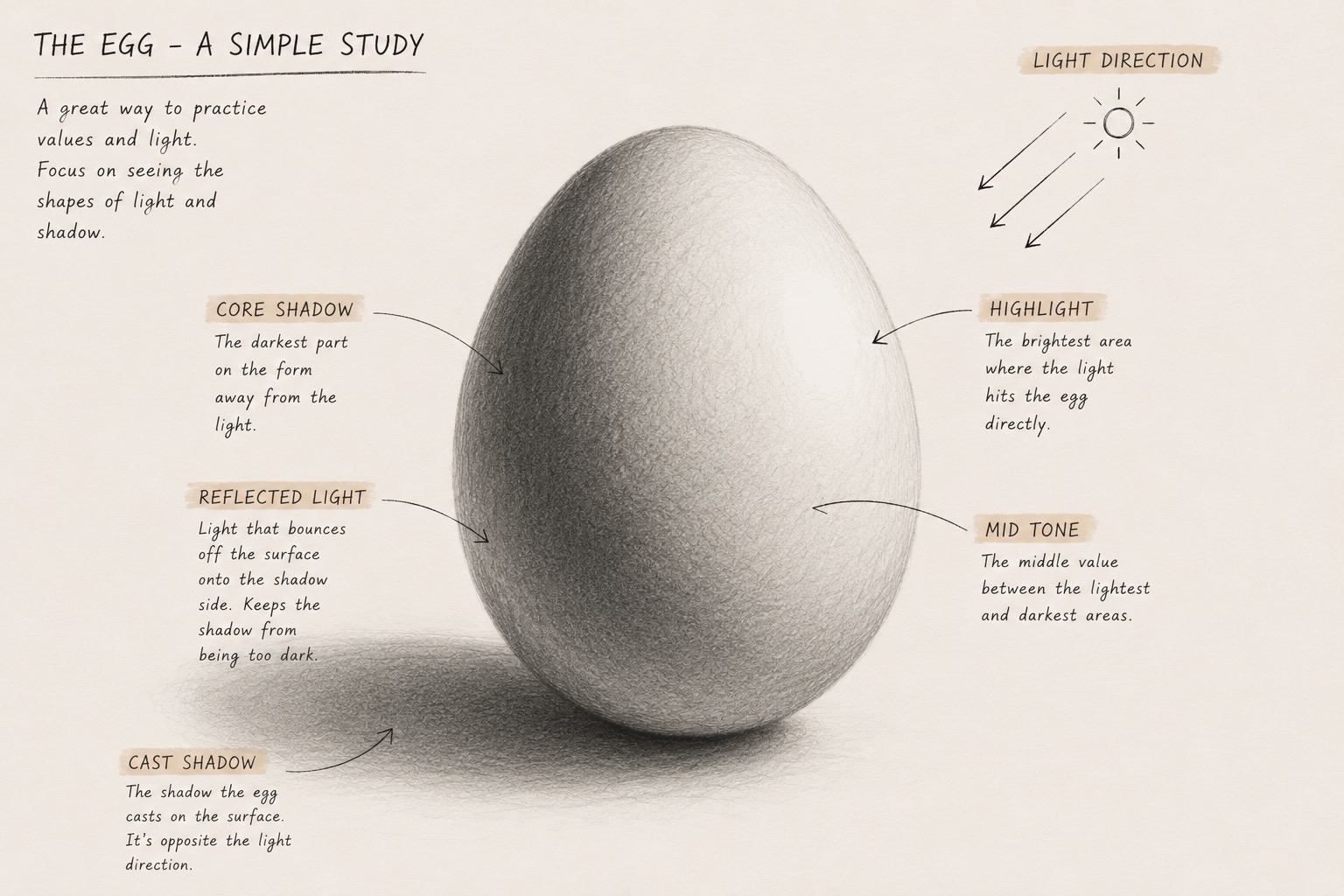
Look at this egg. There is no colour in this drawing — only pencil on paper. Yet your brain reads it instantly as a solid, three-dimensional object sitting on a surface. You can feel the roundness of it, the weight of it, the direction the light is coming from.
That's value doing all the work. The highlight tells you where the light source is. The mid-tone shows where the surface begins to curve away. The core shadow is the darkest point on the form — the part furthest from the light. Reflected light bounces back from the surface beneath and softens the underside of the shadow. The cast shadow anchors the egg to the ground plane. Remove any one of those value relationships and the illusion weakens. Remove them all and you have a flat oval shape.
Value — not colour, not texture, not line — is the reason this egg looks like an egg and not a sticker.
What Is Value in Art?
Value simply means how light or dark something is. Every colour exists on a scale from pure white to pure black, and its position on that scale is its value. A bright lemon yellow is a light value. A deep navy blue is a dark value. A burnt orange and a sage green might look very different as colours, but if you photograph them in black and white, they could come out almost identical in value.
That scale — from white through all the greys to black — is called the value scale, and learning to read it is one of the most important skills a visual artist can develop.
Why Value Matters More Than Colour
The human eye has two types of photoreceptors — cones, which process colour, and rods, which process brightness (value). In low light, colour perception fades but we can still see clearly in greyscale. Our visual system is fundamentally built around value, with colour layered on top.
A black-and-white photograph of a face is immediately readable — you can see the nose, the cheeks, the eye sockets — because the value relationships communicate the three-dimensional form. A flat colour illustration with no value variation, on the other hand, reads as a shape, not a form. This is why a badly valued painting can't be rescued by getting the colours right. The form information lives in the values. If the values aren't working, the colour has nothing to sit on.
The Five Value Zones
Most artists think in terms of five broad zones rather than trying to work with the full continuous value scale. You can see all five clearly labelled in the egg diagram above:
- Highlight — The lightest area where direct light hits most directly. Usually small — highlights that are too large flatten a form.
- Mid-tone — The transition zone where the surface begins to turn away from the light. Getting this right is what makes forms look rounded rather than flat.
- Core shadow — The darkest part of the shadow on the form itself — the area furthest from the light before reflected light begins to soften the edge.
- Reflected light — Light that bounces back from nearby surfaces into the shadow side. It keeps shadows from going completely flat and dead.
- Cast shadow — The shadow the object projects onto the surface beneath it. It anchors the object to the ground and communicates the direction and quality of the light.
Learning to assign every area of your drawing to one of these zones — rather than trying to match every subtle tonal shift — is one of the fastest ways to make your work more readable.
Why Beginners Struggle with Value
There are two common reasons beginners find value difficult.
The first is colour confusion. When looking at a colourful reference, your brain interprets colour contrasts as value contrasts. A red next to a green feels like a strong contrast — but if both are at the same mid-tone value, that contrast disappears when you paint monochromatically or when someone views your work in dim light. This is why experienced artists regularly check their work in greyscale.
The second is the tendency to default to mid-tone. When a value feels uncertain, most beginners hedge and paint it as a safe, inoffensive middle grey. Over time the painting drifts towards the centre of the value scale and loses all its contrast. Paintings that lack contrast look flat and unfinished — not because anything is technically wrong, but because the values are all bunched together in the middle.
How to Train Your Eye to See Value
The most reliable technique is to squint. Squinting blurs detail and suppresses colour perception, leaving you with only the underlying value structure. If the big shapes of light and dark don't read clearly when you squint at your reference, the values aren't working.
A second technique is to convert your reference to greyscale before you start. With colour removed, the value structure is immediately obvious — you can see exactly where the darks are, where the lights are, and whether there's enough contrast to read well. SketchKit's Value Checker does this directly in your browser. Upload any reference photo and it shows you the original and the greyscale conversion side by side, with an adjustable contrast slider that makes the value zones even clearer.
A Simple Exercise to Get Started
Pick any reference photo — a face, a piece of fruit, anything with clear light and shadow. Load it into the Value Checker and increase the contrast to around 150%. Now look at the greyscale version and ask: can you clearly see all five zones — highlight, mid-tone, core shadow, reflected light, and cast shadow? Or are most values compressed into the middle of the scale?
Now do a quick 5-minute sketch using only five values: white, light grey, mid grey, dark grey, and black. Don't blend — just block in flat areas. Compare your result to the greyscale reference. Where are the differences? That gap between what you drew and what the values actually are is exactly where your eye still needs training.
Do this regularly and your value perception will improve faster than almost any other single exercise. The goal is to reach the point where you automatically read value first — before colour, before detail. That shift in perception is when everything about your drawing starts to improve.